


Uber to deploy 30,000 driverless Lucid cars, is 2027 the inflexion point for robotaxis
US ride-hailing company Uber, Nasdaq-listed US EV maker Lucid and California autonomous-driving firm Nuro have started testing robotaxis on public roads in four Bay Area cities with nobody at the wheel. The tests were announced on November 24.
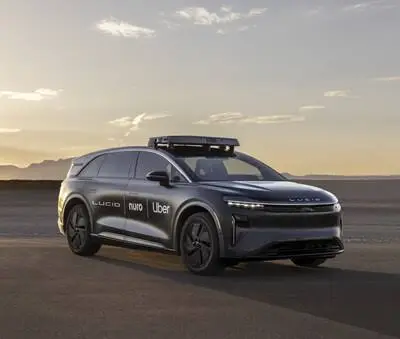
US ride-hailing company Uber, Nasdaq-listed US EV maker Lucid and California autonomous-driving firm Nuro have started testing robotaxis on public roads in four Bay Area cities with nobody at the wheel.
The tests were announced on November 24. They cover Palo Alto, Mountain View, Los Altos and Sunnyvale, and more cities will be added next year. Lucid has supplied more than 100 Gravity SUVs fitted with the Nuro Driver system and redundant cameras, lidar and radar. Employee rides come next, and a public launch is planned for Q1 2027.
The tests run under a California DMV driverless testing permit that Nuro received this spring. It covers Santa Clara and San Mateo counties at up to 45 mph, day or night. Nuro also has a Public Utilities Commission permit, but that one only lets it carry passengers with a safety driver on board and without charging fares.
To sell driverless rides it still needs a DMV deployment permit and a ride-hailing permit from the commission. “Removing the safety operator from behind the wheel is an important milestone in our partnership,” a senior executive at Uber was quoted as saying.
Uber has committed to buy at least 35,000 Lucid vehicles, up from 20,000 when the deal was signed in July 2025. It has also raised its investment in Lucid to USD 500 million (INR 4,666 crore).

The work is split four ways: Uber and its fleet partners own the cars, Nuro supplies the driving software, Lucid builds the vehicles in Arizona, and Uber sells the rides, only through its own app. That split matters more than the test itself. In the US, Alphabet’s robotaxi unit Waymo has largely shown that the technology works.
According to media reports, it runs about 4,000 vehicles in 15 cities and carries more than 500,000 paid rides a week, and it is targeting 1 million by year-end. The competition is now over who owns the vehicle, the software, the rider and the depreciation.
For Uber this is a reversal. It stopped developing its own self-driving cars in 2020, two years after one of its test cars was involved in a fatal crash in Arizona.
Since then it has acted as a marketplace for other companies’ robotaxis, from Waymo in Austin to Baidu in Dubai. Buying 35,000 vehicles based on a USD 80,000 (INR 74.7 lakh) SUV puts that capital back on its own books. At Waymo’s rate of about 125 paid rides per vehicle a week, a fleet that size would carry roughly 4.4 million rides a week.
For loss-making Lucid, a guaranteed buyer provides volume its luxury sales have not. In August, as he pursued a USD 1.4 billion cash-flow improvement plan, chief executive Silvio Napoli said “potential is not performance.”
China shows what scale looks like, on cheaper hardware. Baidu’s Apollo Go completed 3.2 million fully driverless rides in Q1 2026, a volume growing at over 120% year-over-year, and reached 30 cities by October 2026. Pony.ai began making a profit per vehicle in Guangzhou in November 2025 and in Shenzhen in February 2026, using mass-produced, purpose-built robotaxis rather than a premium SUV. One caution: Baidu’s Q3 2026 results stopped reporting a quarterly ride count.
In the Gulf, Uber already distributes Chinese robotaxis. Since August 2026, riders in Dubai have been able to book driverless Apollo Go cars through the Uber app, and the emirate wants 25% of all transportation trips to be smart and driverless by 2030. WeRide reports that its vehicles break even per unit in Abu Dhabi.
Goldman Sachs Research expects the global robotaxi fleet to grow from roughly 7,000 vehicles last year to about 1 million in 2030 and approximately 6 million in 2035, which it values at about USD 415 billion.
McKinsey puts the market at USD 190-430 billion by 2035 and expects the cost per kilometre to fall by almost 80%. In McKinsey’s survey, 87% of US riders rated their robotaxi experience positively. The number of US cities with commercial service rose from 3 at end-2024 to 15 in September 2026. Driverless testing does not guarantee a commercial service.
General Motors’ Cruise began driverless testing in San Francisco in December 2020. It lost its permit after one of its cars dragged a pedestrian in October 2023, and GM shut the business in December 2024.
India remains outside this market. In December 2023, road transport minister Nitin Gadkari said he would never allow driverless vehicles, citing 7-8 million driving jobs. For Indian suppliers, the opportunity for now is in sensors, software and the Gulf deployments. For carmakers everywhere, value is moving to whoever owns the software, the rider and the utilisation data, and a company that only builds the vehicle risks becoming a contract supplier.
Related Stories
Toyota launches India’s first E85 flex-fuel hybrid Innova HyCross at INR 19.99 lakh: Will it really cut what owners pay per km?
E85 sells for INR 20 a litre less than petrol, but each litre holds about 24% less energy....
Archer’s UAE air taxis now to fly before 2028, after Q1 2026 target, Joby Aviation to start in 2026
US electric air-taxi maker Archer Aviation aims to start passenger operations in the UAE before its planned service...
BloombergNEF sees 6 lakh electric cars in India by 2030. What happened to the 16-million projection?
Nearly a decade ago, India's electric mobility future was being imagined on a scale that would have transformed...