


German auto suppliers are turning factories into a second industry as car orders weaken
The shift into drones, defence, space and robotics is no longer just diversification. Suppliers are looking to repurpose their engineering capabilities as automotive volumes, margins and programme visibility deteriorate.
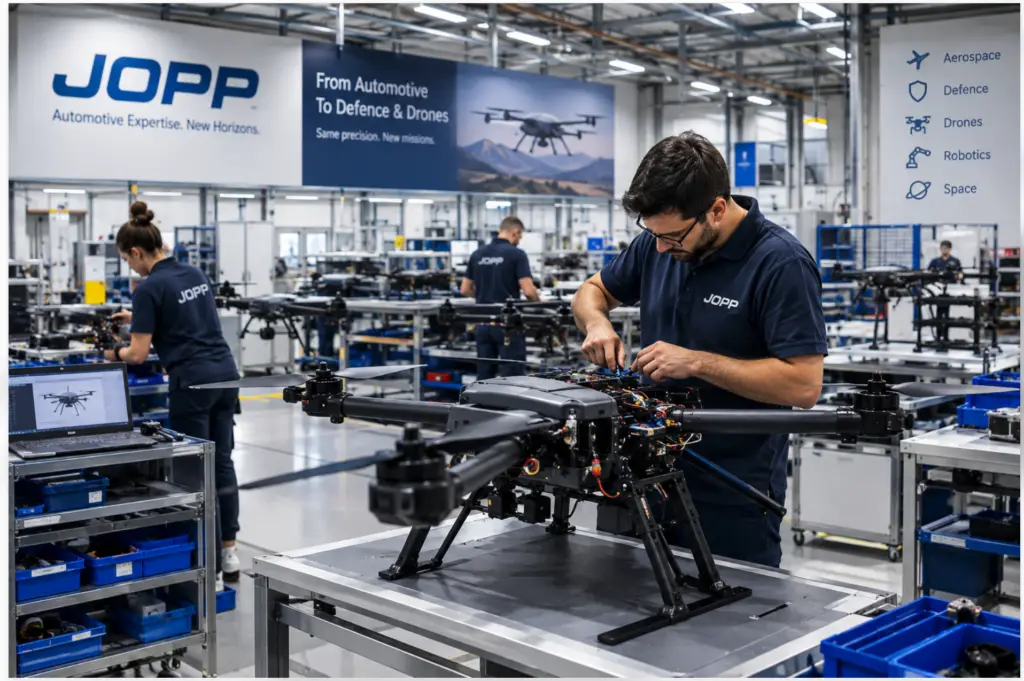
The shift into drones, defence, space and robotics is no longer just diversification. Suppliers are looking to repurpose their engineering capabilities as automotive volumes, margins and programme visibility deteriorate.
Germany’s automotive supply chain is beginning to look beyond the car—not because its manufacturing expertise has lost relevance, but because the industries absorbing that expertise are changing.
Companies such as Jopp Group and Schaeffler are moving into drones, defence and space technology as falling volumes, delayed automotive programmes, price pressure and global competition weaken the traditional supplier business. The shift is increasingly about redeploying industrial capacity rather than simply finding new customers.
Bavarian supplier Jopp offers a revealing example. As a Porsche gear-system programme approached its end, the family-owned manufacturer moved into surveillance-drone production through a partnership with defence technology start-up Highcat.

The company has capacity to manufacture 1,000 drones a month and aims to reduce automotive’s contribution to revenue from 85% currently to 60% by 2035. Its workforce has fallen from about 2,000 six years ago to 1,400, with two factories closed.
The pivot is not restricted to smaller suppliers. Schaeffler is extending its precision-engineering and motion-technology capabilities into space infrastructure, partnering with Spire Global on spacecraft subsystems and satellite platforms. It is also moving into defence drones, including products developed by France’s Delair.
The strategic logic is straightforward: capabilities developed for automotive manufacturing—precision components, bearings, motors, electronics, process control, high-volume quality systems and industrialisation—can find applications in new sectors.
But the economics are fundamentally different. Automotive programmes offer long production cycles and predictable volumes; defence and space contracts can be smaller, dependent on budgets, certification and procurement cycles. New business may absorb idle capacity without replacing automotive revenue on a comparable scale.
The pressure is structural. Germany has lost more than 140,000 automotive jobs since 2019, while suppliers are increasingly exploring medical technology, robotics, space and defence.
The bigger transformation may therefore be the reshaping of the supplier itself—from a company built around the production cycle of a vehicle programme into a multi-industry manufacturing business.
Diversification can protect factories, capabilities and jobs. But it cannot, by itself, repair the competitiveness of Europe’s automotive industry.
Related Stories

Hyundai Motor Company supplier base gets ₹1,370 crore boost as Hwashin Automotive, SEOYON E-HWA SUMMIT ANANTAPUR plan Tamil Nadu expansion
Two South Korean automotive component manufacturers, Hwashin Automotive India and SEOYON E-HWA SUMMIT ANANTAPUR have proposed investments totalling...
Can India’s auto companies escape Marelli’s $4.9bn bankruptcy?
When a global supplier with 16 production sites and three R&D centres in India goes bust, the Indian...

CBAM Casts a Shadow Over India’s $6.8-Billion Auto Component Exports to Europe, and Over European Carmakers Too
Europe’s carbon levy does not cover cars or car parts, but it taxes the metals they are made...