


BloombergNEF sees 6 lakh electric cars in India by 2030. What happened to the 16-million projection?
Nearly a decade ago, India's electric mobility future was being imagined on a scale that would have transformed the automobile industry within a few years. The market, however, is now heading towards a very different destination — and the latest BloombergNEF outlook offers a measure of
Nearly a decade ago, India’s electric mobility future was being imagined on a scale that would have transformed the automobile industry within a few years. The market, however, is now heading towards a very different destination — and the latest BloombergNEF outlook offers a measure of how far those early ambitions have diverged from reality.
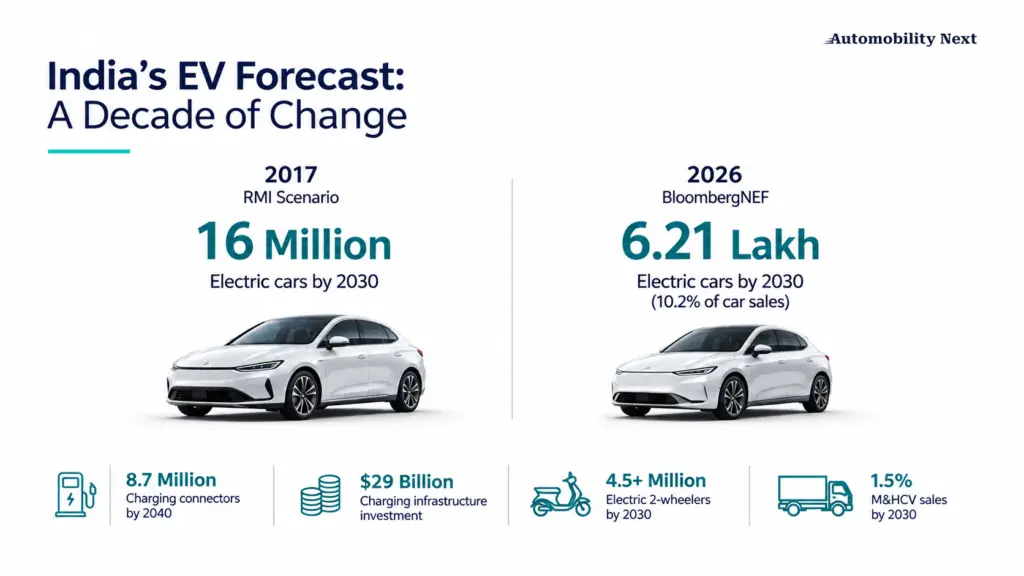
BloombergNEF expects India to sell 621,000 electric passenger vehicles in 2030, accounting for 10.2% of new passenger vehicle sales. In 2017, a FICCI–Rocky Mountain Institute (RMI) report envisaged nearly 16 million electric four-wheelers being sold annually by 2030, with electric vehicles overtaking internal-combustion cars around 2027.
The two numbers are not directly comparable forecasts. The RMI figure was an ambitious transformation scenario, built around a systemic shift towards shared, electric and connected mobility. But the contrast is striking: a vision of near-total four-wheeler electrification has given way to a market-based projection in which electric cars remain a minority of new sales even at the end of this decade.
India’s EV market is growing, not shrinking. Sales exceeded 2.4 million vehicles in 2025, up 17%, and reached 2.9 million during the first 10 months of 2026. Passenger EV sales are expected to cross 305,000 this year, a 42% increase, yet their share of passenger vehicle sales stands at only 6.7%.

The gap between ambition and projection, therefore, is less about whether Indians are buying EVs and more about how quickly electrification can move beyond its early adopters.
The economics behind the forecast
BloombergNEF’s Economic Transition Scenario models EV adoption primarily on market economics rather than assuming additional policy intervention will deliver the transition. Its projections suggest passenger EV sales nearly double by 2030 and reach 5.2 million annually by 2040. The trajectory assumes lower battery costs, more affordable models, improved charging access and lower operating expenses will progressively make EVs competitive.
But the economics do not work equally well across vehicle categories.
In passenger cars, private buyers — rather than shared mobility fleets — are driving adoption. BloombergNEF attributes this partly to the limited availability of affordable EVs suited to fleet operations and the competition from CNG cars, which also offer relatively low running costs. For consumers, the savings from electricity may not be enough to offset the initial price premium, particularly where charging access is uncertain or a vehicle is used primarily for shorter urban journeys.
Two-wheelers face a similar divide. Electric scooters have a more straightforward urban use case, but motorcycles — which represent a critical part of India’s mobility market — are electrifying more slowly. BloombergNEF expects electric two-wheeler sales to exceed 4.5 million annually by 2030, but scooter-led growth alone may not be enough to meet the government’s 80% target.
The problem becomes more complex in commercial transport. Medium and heavy trucks need to balance battery weight, payload, range, charging time, capital cost and utilisation. BloombergNEF projects electric vehicles will account for only 1.5% of medium- and heavy-commercial vehicle sales by 2030, although the share could rise to 40.4% by 2040
This is the reason the EV transition cannot be measured through one headline penetration target. The economics of an electric three-wheeler operating throughout the day are fundamentally different from those of a private car or a long-haul truck.
The transition has a cost beyond the vehicle
One of the less discussed implications of the BloombergNEF outlook is the scale of infrastructure India will need even if EV adoption follows a slower, more commercially realistic path.
India could require 8.7 million charging connectors by 2040, involving an estimated $29 billion investment. Charging demand could exceed 96 terawatt-hours annually, or 6.8% of India’s total electricity demand by then. The transition, therefore, is not simply about automakers introducing more electric models. It requires capital for charging networks, distribution upgrades, grid capacity and the ability to deliver electricity where vehicles need it.
The oil-demand projection is equally revealing. India’s road transport fuel consumption is expected to continue rising until 2034, peaking at more than 2.5 million barrels a day before declining to just over 2.3 million barrels a day by 2040. Electrification will reduce consumption from passenger cars, two- and three-wheelers, but growing commercial vehicle activity will continue to push demand upwards.
Related Stories
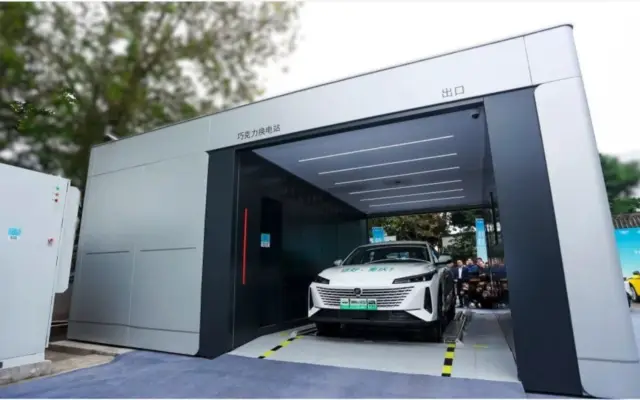
CATL wants to own the battery ecosystem, not just supply carmakers
With 6,000 swap stations planned by 2027, aircraft battery deals and a growing infrastructure play, the Chinese giant...