


CAFE-III: India’s new fuel rules put ethanol and batteries in the driver’s seat
The notification rewards electric cars and ethanol, and makes diesel harder to justify. Tata and Maruti look well placed, and sugar mills and distillers stand to gain the most.
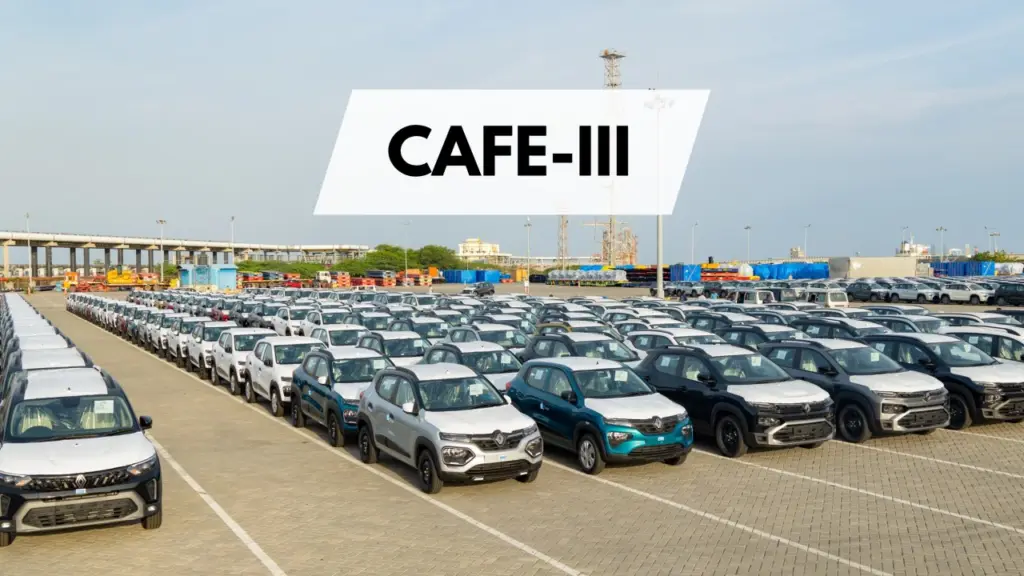
India’s carmakers now know their targets up to 2032, and ethanol makers have plenty to celebrate. On September 29th, the Ministry of Power published Gazette notification S.O. 5346(E), signed by Diwakar Nath Mishra, an additional secretary. It sets the third round of Corporate Average Fuel Economy norms, known as CAFE-III, for every passenger vehicle made or imported for sale in India from April 2027 to March 2032. That means cars, SUVs and MPVs with up to eight passenger seats.
The rules do not cap any single model. Instead, each carmaker’s whole fleet must stay under a line that the government lowers every year. Two things pull a fleet’s average below that line most easily. Electric cars count as three cars each. And any petrol car running on E20, the 20%-ethanol blend now sold at pumps across India, has 8% less measured CO₂. The notification is the product of a year of lobbying, and it shows who won the arguments.
The arithmetic is easy to state. All figures are petrol-equivalent and measured on India’s MIDC laboratory test. A carmaker whose cars have an average unladen weight of 1,229kg must keep its fleet below 3.996 litres per 100km (about 94.8g of CO₂ per km) in 2027-28, which is roughly 25km a litre. By 2031-32 the limit falls to 3.327 litres (78.9g), or about 30km a litre. That is a cut of about a sixth in five years. Heavier fleets get a little more room, but not much. Each extra 100kg of average weight allows 0.158 litres per 100km in the first year and only 0.131 litres in the last. For a maker whose cars average 1,600kg, the target falls from 108.7g to 90.4g. For one whose cars average a tonne, it falls from 86.2g to 71.8g.
The small-car fight
That weight curve became the focus of the bitterest argument. According to media reports, a draft in September 2025 offered a 3g concession to petrol cars weighing under 909kg. Maruti Suzuki, which dominates small cars, pushed hard for it. Tata Motors and JSW MG Motor opposed it just as hard, arguing that it would benefit a segment dominated by one company.

The dispute reportedly went as far as the prime minister’s office. The final rules contain no such carve-out. Instead, according to the same reports, the reference weight was raised from the draft’s 1,170kg to 1,229kg, and the weight slope was flattened. A flatter slope means lighter fleets see their targets cut by less. Maruti appears to have lost the argument but won much of the substance.
Batteries count triple
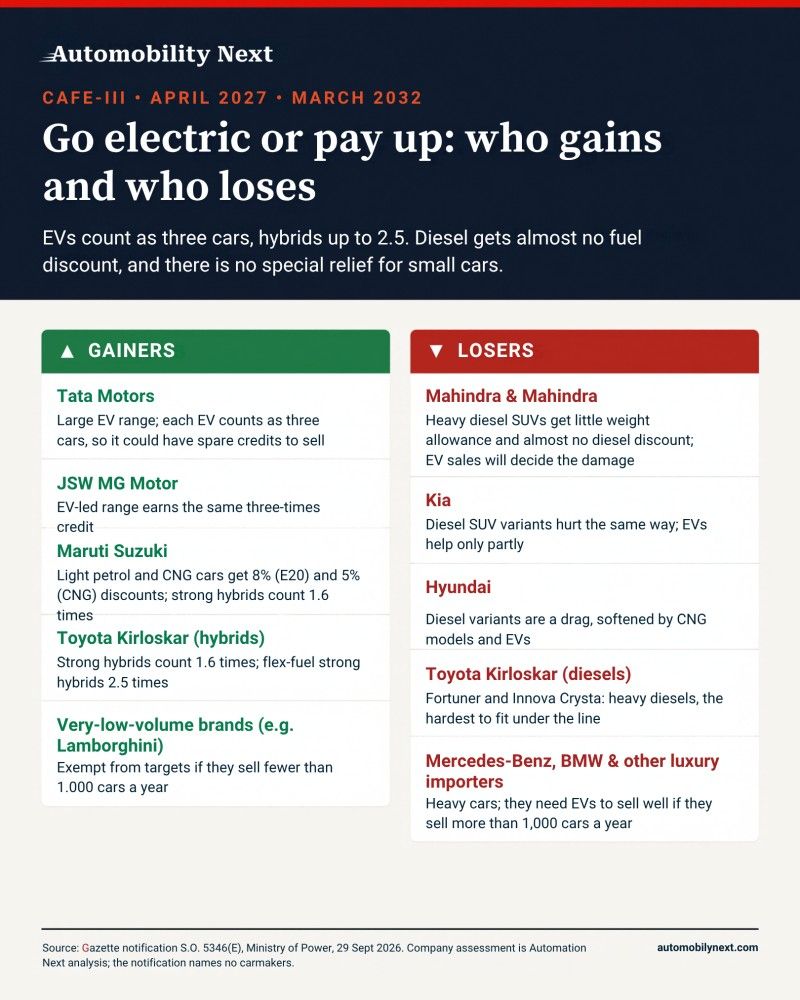
The most generous part of the rules is how clean cars are counted. Carmakers may count each battery-electric or range-extended electric car as three cars in the fleet average. A plug-in hybrid, or a strong hybrid that can run on high-ethanol fuel, counts as 2.5. An ordinary strong hybrid counts as 1.6 and a flex-fuel car as 1.1. The weightings affect only the average: credits and debits are still calculated on the number of cars actually sold. Electric cars are not treated as producing nothing: their electricity use is converted into petrol-equivalent litres at a factor of 0.1028. But because they use little energy and count three times, a few go a long way. An EV using 13kWh per 100km counts as about 1.3 litres. A maker selling nine petrol cars at 4.2 litres for every such EV would cut its fleet average by roughly a sixth, about as much as the entire five-year tightening.
Ethanol’s sweet deal
The biggest quiet winner is ethanol. The rules introduce a “carbon-neutrality factor”, which knocks a share off a car’s declared tailpipe CO₂ depending on the fuel it burns. Petrol cars that run on E20 or higher blends get 8% off, including strong hybrids and plug-ins. Since E20 is already the standard pump fuel across India, almost every petrol car qualifies from day one. The discount is worth nearly half as much as the whole five-year tightening, though the targets were presumably set with it in mind.
Flex-fuel cars, which can run on E85 or pure ethanol (E100), get 22.3% off, plus the 1.1 weighting. A flex-fuel strong hybrid is weighted at 2.5, not far below a battery car. As a flex-fuel vehicle, it also appears to qualify for the 22.3% discount, though the notification does not say so outright. CNG gets at least 5%, or more if the petroleum ministry mandates more compressed biogas blending. Diesel gets only as much as its actual biofuel content, which today is close to nothing.
The timing is no accident. On June 5th, Maruti unveiled a production-ready flex-fuel Wagon R that runs on E100, at an event attended by Nitin Gadkari, the transport minister and ethanol’s loudest champion in government, and Hardeep Singh Puri, the petroleum minister. No sale date has been set. The formula now gives other carmakers a reason to follow. That is good news for sugar mills and grain distillers, for the cane and maize farmers who supply them, and for firms that build ethanol plants. It also fits the government’s aim of cutting oil imports. The obstacles lie outside the rulebook. Few pumps sell E100. Ethanol holds less energy than petrol, so mileage suffers. Drivers also worry about resale values.
Diesel squeezed
The rules do not ban diesel; they simply stop helping it. A litre of diesel counts as 1.117 litres of petrol, reflecting its higher carbon content, so gram for gram of CO₂, the two fuels are treated alike. The difference is that petrol now gets an 8% ethanol discount and diesel does not. An ordinary diesel car also earns no multiplier. Diesel hybrids would still get the hybrid weightings, but few are sold in India. Diesel engines are efficient enough that this penalty is modest. But for makers of heavy diesel SUVs it arrives just as their weight allowance is shrinking. The logical response is to cut prices on hybrids and EVs and let diesel slowly fade.
Gadgets and the price of failure
Carmakers can also claim 1g per km for each of 12 listed fuel-saving technologies fitted to a car, up to a cap of 9g. The list includes start-stop engines, regenerative braking, gearboxes with six or more speeds, 12V/48V motor-generators, efficient alternators, all-LED exterior lights, tyre-pressure monitors, heat-controlling glass, electric water pumps, efficient air-conditioning, solar-reflective paint and variable-speed radiator fans. For the first compliance block (2027-30), carmakers need only declare these savings themselves. After that, they must prove them in tests set by the transport ministry.
Compliance is checked every year, but settled in blocks: the first runs from 2027 to 2030 and the second from 2030 to 2032. A carmaker that misses its target in one year can carry the debit forward and make it up later in the same block. It can also buy credits from rivals that beat their targets, on whatever terms they agree, or from the Bureau of Energy Efficiency (BEE). The Bureau’s price starts at ₹2,500 per gram per km for 2027-28 and rises by ₹500 a year to ₹4,500 for 2031-32. The shortfall multiplies with every car sold, so the sums add up quickly. A maker selling 1 lakh cars that misses by 2g would face a bill of ₹50 crore at the first year’s price and ₹90 crore at the last.
Debits can be settled only during a trading window from October 1st to 31st of the year after sales, so the first window opens in October 2028. Credits still unused at the end of a block lapse. Makers still short at that point face penalties under sections 26 to 28 of the Energy Conservation Act. Firms selling fewer than 1,000 cars a year need only report their figures. The work is split between agencies. The transport ministry enforces testing and the discounts, a “Designated Agency” gathers the data, and BEE keeps each firm’s credit account and sells credits.

Cheers and jeers
The industry is pleased. On September 30th, Shenu Agarwal, president of the Society of Indian Automobile Manufacturers (SIAM), said that carmakers “appreciate and welcome” the notification. He described it as “a structured roadmap with aggressive annual targets for the next 5 years” with “a market-based compliance mechanism”. He said it would let the industry “work on various technology pathways providing multiple choices to the consumers”. Above all, he said, it offers “clear predictability which will enable the Auto industry to plan investments and accelerate innovation”. He thanked the government for its “detailed and transparent consultative approach” and its “objective and balanced assessment of various clean technology options”. Carmakers fought each other bitterly over the small-car concession. That they now speak with one voice suggests most of them think they can live with the result.
Not everyone is so warm. Amitabh Kant, a former head of NITI Aayog, a government think tank, calls the rules “backwards-looking” and a “huge missed opportunity”. He also objects to BEE’s double role as regulator and seller of credits: “a regulator can’t be a player in the market it regulates.”
The notification says nothing about prices, taxes or which cars may be sold. Its effects will come through what carmakers choose to push:
- More EVs, hybrids, CNG and flex-fuel models, possibly at sharper prices, because the formula rewards them.
- More fuel-saving features as standard, even on cheap cars, since each one earns an allowance.
- Fewer diesel models, or dearer ones, as the fuel becomes harder for carmakers to justify.
The rules also bring in new reporting. For every model sold from April 2027, carmakers must declare CO₂ on both India’s MIDC test and the tougher international WLTP test. The Ministry of Power will separately notify a factor for converting targets between the two, which looks like groundwork for moving India onto WLTP. Carmakers must also report sales state by state each year. These figures go to the government, and the rules say nothing about making them public.
Related Stories

India’s First E85 Car Found Three Buyers in Its First Month: An Analysis of the Supply-First Ethanol Gamble
E85 reached 48 pumps in June 2026, well ahead of any mandate forcing its use. The first car...
Gadkari says 100% ethanol cars can cost Rs 25/litre to run, but oil companies pay Rs 71/litre for ethanol
Union Road Transport and Highways Minister Nitin Gadkari recently said that vehicles running entirely on ethanol can bring...