


Tata’s €3.8 Billion Iveco Deal Buys Europe’s Bus Leader, an Engine Maker and a Margin Problem
Tata Motors has won access to Iveco's European and Latin American markets, its established technologies and its manufacturing capabilities. But its biggest overseas acquisition also arrives with a struggling truck business, falling margins and a costly turnaround still ahead.
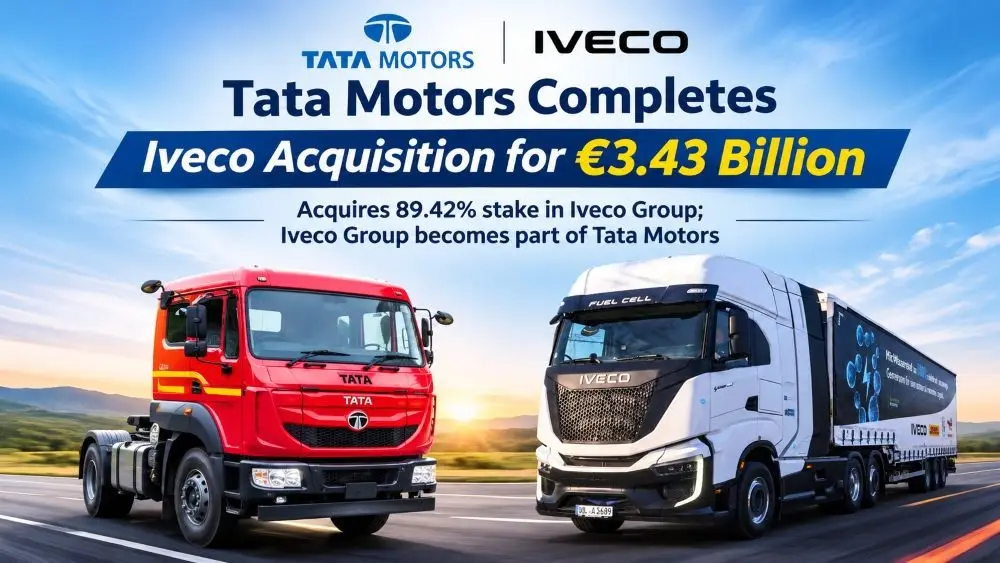
On November 7, Tata Motors Ltd. told Indian stock exchanges that it now owns 96.29% of Iveco Group NV. The final stretch came through the reopened tender offer, where it picked up another 6.75% for €263.65 million. Crossing the 95% line matters: under Dutch law, it lets Tata squeeze out the remaining shareholders and take Iveco off the Milan exchange.
For Tata Motors, this is its largest overseas acquisition, and the biggest test of its global ambitions since Jaguar Land Rover in 2008. Nobody is asking whether Iveco has valuable assets. It does. The real question is whether Tata bought the right ones, at a price that still holds up after Iveco’s 2026 profit slump.
Cheap on paper, costly to fix
On paper, the price looks modest. Tata is paying about €3.8 billion in cash for Iveco, excluding the defence unit sold to Leonardo. The final offer of €14.40 a share, raised from €14.10 on October 9, works out to about 5.9 times Iveco’s 2025 adjusted EBIT of €645 million.
But that multiple belongs to a better year. Current earnings tell a different story. Adjusted EBIT fell to €131 million in the second quarter of 2026, down from €171 million a year earlier, Iveco said in its July 30 results. By the third quarter, it had shrunk to about €30 million on revenue of €3.16 billion — a margin of roughly 1%, according to Iveco’s November 4 results. In the same quarter, free cash flow was an outflow of €656 million.

The financing adds another layer of pressure. A €3.875 billion bridge loan is to be refinanced over 12 to 18 months, media reports said. CRISIL Ratings expects that refinancing to be about 70% debt and 30% equity. Tata Motors’ group chief financial officer, PB Balaji, has said the company plans to raise about €1 billion in equity, including by selling its Tata Capital stake. He has said the deal should add to earnings per share from year two, with the acquisition debt repaid within four years.
S&P Global Ratings, which rates Tata Motors BBB with a stable outlook, sees the deal as broadly neutral for the rating. It also sounds a warning: the combined EBITDA margin could fall to about 8%, and Iveco may need more investment.
What Iveco really is
Look past the slump and Iveco is a solvent company going through a bad patch, not a distressed one. It held €3.7 billion of liquidity at the end of September. Revenue from continuing operations was €13.4 billion in 2025, down 7%. Management puts the 2026 weakness down to a deliberate quality overhaul, including rework on delayed city buses, and says those costs peaked in the third quarter.
Open the hood, and the businesses are uneven — a mix of clear strengths and visible weak spots:
- Coaches: The crown jewel. Iveco holds 50.5% of Europe’s intercity bus market, according to its 2024 annual report. A clear leader.
- Vans: The Daily held 11.7% of its segment and 29.7% of chassis cabs in Q3 2025, the company said.
- Engines: FPT Industrial sells 48% of its output to outside customers, from tractor makers to marine makers.
- Heavy trucks: Here the picture dims. Iveco had about 11% of Europe’s market above 6 tonnes in 2025, behind Volvo at 18%, Mercedes-Benz and Scania at 16% each, and MAN at 15%, according to ING Research. The ICCT found Iveco lost 1.6 percentage points of Europe’s heavy-duty market in the first half of 2026, the biggest drop of any maker.
- Heavy electric trucks: Just six sold in Europe in Q1 2026, according to the ICCT.
The picture that emerges is clear. Iveco is not a top-five European truck maker. It is number one in coaches and a solid player in vans.
Market access
Tata’s international business is already picking up speed. Overseas volumes rose 177% to 21,132 units in July–September, against 113,982 at home, Tata Motors said in its Q2 FY27 results on October 23. What Iveco hands it is something years of exporting could not build: dealers, service networks, homologated products and a finance arm across Western Europe. On top of that come a sizeable truck and bus business in Latin America and FPT’s industrial customers. When the two companies announced the deal on July 30, 2025, they put combined revenue at about €22 billion, and Tata says the group becomes the world’s fourth-largest commercial vehicle maker.
The map still has blank spaces, though. Iveco does not bring North America, China, or pricing power in long-haul heavy tractors — territory where Daimler, Volvo and Traton dominate.
Technology: less new than advertised
Tata already has hydrogen of its own. It began trials of hydrogen-combustion and fuel-cell trucks on Indian freight routes in March 2025 and runs 15 fuel-cell buses. Its electric commercial vehicle volumes grew 2.4 times year on year last quarter. It also sells CNG and LNG trucks and owns Tata Daewoo in South Korea. Iveco’s own hydrogen venture with Nikola, by contrast, ended in 2023, and Nikola later went bankrupt.
Where Iveco genuinely fills the gaps:
- Heavy engines proven to Euro VI and beyond, arriving ahead of India’s next emission norms.
- Long-haul gas: the S-Way LNG, with a 500 hp FPT engine and a range of up to about 1,700 km, according to Iveco.
- A 3.5–7.2 tonne van platform, plus the electric eDaily. Tata has nothing comparable.
- Coach and city-bus engineering built to European standards.
Don’t expect this technology to cross over quickly. European engines rely on costly after-treatment systems that Indian fleet economics do not yet reward. The faster gain runs the other way, with Indian parts and engineering cutting Iveco’s costs.
What Iveco gets
For Iveco, the prize is a profitable parent. Tata Motors reported consolidated profit of ₹1,254 crore for Q2 FY27, free cash flow of ₹4,606 crore and standalone net cash of about ₹11,300 crore. Iveco also gains cheaper sourcing, a route for FPT into India, and freedom from quarterly market scrutiny while it fixes quality. The price it pays is independence. Tata’s pledge of no layoffs or plant closures runs for only two years after settlement, and Italy’s government has said it will monitor the commitments, media reports said.
The verdict
The deal is worth the money only if Tata runs Iveco as a portfolio. That means investing in FPT, coaches and the Daily, and either fixing heavy trucks or finding partners for them. Partnerships could have brought Tata a gas engine or a van but not a European customer base or a coach business.
Three tests will decide how this story ends. First, whether margins recover in Q4 2026, as Iveco has promised. Second, how much it costs to refinance the bridge loan. Third, whether Iveco produces a heavy electric truck plan before the EU’s 2030 CO₂ targets for heavy vehicles take effect. The hardest restructuring decisions will come after late 2028, when the job guarantees expire.
Related Stories
More trucks, fuller factories, higher costs: Is Ashok Leyland paying a price for the freight boom?
India’s road-freight boom is proving to be a double-edged sword for Ashok Leyland. It is bringing customers back...